
What Happened in 1776? The Year America Was Born—and Nearly Lost
From failed reconciliation and Common Sense to the Declaration of Independence, French assistance, military disaster, and Washington's victory at Trenton, 1776 was not simply America's birth year. It was the year Americans chose an uncertain future of self-government—and then struggled to keep that choice alive.
On January 1, America Did Not Exist
On January 1, 1776, there was no United States of America.
There was no Constitution. No president. No recognized American republic. The thirteen colonies stretched along the Atlantic coast as part of the British Empire, and although war had already begun, independence was not yet inevitable.
That is easy to forget because we know how the story ends. The Americans living through 1776 did not.
According to The Chronicle of America, even after fighting began at Lexington and Concord in April 1775, many colonists continued to believe they were fighting for their rightful place within the British Empire rather than for complete independence. Only gradually did that goal begin to change.
That uncertainty is the key to understanding 1776.
The year did not begin with Americans celebrating the creation of a new nation. It began with people confronting a rapidly narrowing choice between reconciliation and separation.
By July, they would choose independence. By December, they would be fighting desperately to keep it.
That is the story of 1776: rebellion became independence, independence nearly became defeat, and defeat gave way to the resolve necessary to keep the American experiment alive.
In other words, 1776 was the year Americans had to create a country politically, justify it philosophically, begin building it institutionally, finance it economically, defend it militarily, and convince the world that it deserved to survive.
Reconciliation Was Running Out of Road
Before Americans embraced independence, many had tried to avoid it.
In July 1775, the Second Continental Congress sent the Olive Branch Petition to King George III in a final major attempt at reconciliation. Yet the political situation continued deteriorating, and in August the king declared the colonies to be in a state of rebellion.
Britain's response made reconciliation increasingly difficult to imagine. Parliament's Prohibitory Act further restricted American trade, while Britain prepared to use greater military force to suppress the rebellion.
British authorities also arranged for thousands of troops from German states to serve in North America. Americans commonly referred to these soldiers as Hessians, although they came from several German territories.
For Patriot leaders, Britain's use of German troops became powerful evidence that the conflict was changing. A dispute between British subjects and their government increasingly looked like a war.
That transformation raised a question Americans could no longer postpone: If Britain increasingly treated the colonies as enemies, how long could colonists continue insisting they were merely British subjects seeking restoration of their traditional rights?
Into that moment stepped Thomas Paine.
January 1776: Common Sense Changes the Argument
In January, Thomas Paine published Common Sense.
His argument pushed beyond objections to particular taxes or acts of Parliament. Paine challenged the political relationship itself and made the case for independence and republican government accessible to ordinary readers.
The pamphlet did not single-handedly create the independence movement. But it arrived when reconciliation was already becoming less plausible and helped move the public debate toward a question that had once seemed radical: Why remain part of the British Empire at all?
As political circumstances changed, support for independence spread. By the middle of May, eight colonies had decided to support independence, according to the National Archives.
But before America could declare independence, Americans first had to imagine something that had never existed. They had to imagine America itself.
Thirteen Colonies Had to Become Something More
The thirteen colonies were not thirteen identical pieces waiting to form the United States.
They possessed different economies, political traditions, religious communities, regional interests, and histories. People often identified strongly with their individual colony rather than with the national identity Americans take for granted today.
Yet war was forcing them together.
Even before the Declaration, several colonies began creating written constitutions and new governments. According to The Chronicle of America, Americans were designing political systems at the same time they were fighting the Revolution.
That makes 1776 about more than separation from Britain. It was a year of national self-definition.
Americans increasingly had to decide not only what they opposed, but what they believed legitimate government should look like.
And those political questions existed within a society in which faith remained deeply influential.
This was not theoretical nation-building. During 1776, former colonial governments and conventions were drafting constitutions, redefining political authority, and deciding how republican government would actually operate. Independence therefore required Americans to replace institutions they were rejecting with institutions they hoped could endure.
The transformation was already underway before July 4: resistance was becoming government.
Faith, Providence and the Meaning of Liberty
Christianity was deeply woven into colonial American life, but that did not mean Christians agreed politically.
Patriot ministers could defend resistance. Loyalist Christians could reach different conclusions about obedience to established authority. Quaker commitments to pacifism offered another response.
Faith did not produce one political position.
Nevertheless, Christianity was an important part of the intellectual and moral environment in which Americans debated providence, conscience, human nature, duty, liberty, and legitimate authority.
That distinction becomes important when we reach the Declaration itself.
The Declaration was not a Christian creed, nor did its political philosophy come exclusively from Christianity. The founding generation also drew upon natural law, English constitutional traditions, republican thought, and Enlightenment philosophy.
But neither was the Declaration religiously empty.
It speaks of “Nature's God,” a “Creator,” the “Supreme Judge of the world,” and “divine Providence.” Those words belong to the actual document.
And before Americans could issue that document, independence first had to move from public argument to political action.
Spring 1776: Independence Becomes a Political Movement
During the spring, colony after colony moved closer to separation.
On May 15, the Virginia Convention instructed its delegates in Congress to propose that the colonies be declared free and independent states.
Virginia delegate Richard Henry Lee followed those instructions. On June 7, he introduced a resolution declaring that the United Colonies ought to be “free and independent States.”
But Lee's proposal contained more than independence. It also called for efforts to secure foreign alliances and to develop a plan of confederation.
That combination reveals how enormous the decision had become.
America would need to declare itself independent. It would need to govern itself. And it would need relationships with other nations if it hoped to survive.
First, however, Congress had to decide whether to break permanently with Britain.
America Actually Voted for Independence on July 2
Here is one of the most misunderstood facts about 1776: the Continental Congress voted for independence on July 2—not July 4.
On July 2, twelve colonial delegations approved Lee's independence resolution. New York abstained because its delegates had not yet received authorization to vote for independence.
John Adams believed July 2 would become the great anniversary Americans celebrated.
So why July 4?
Because independence required more than a vote. America needed to explain why it was separating from Britain.
The Committee of Five and the Declaration
While Congress considered Lee's resolution, it appointed a committee to prepare a declaration explaining the colonies' case.
The Committee of Five consisted of Thomas Jefferson, John Adams, Benjamin Franklin, Roger Sherman, and Robert R. Livingston.
Jefferson produced the principal draft. Adams and Franklin reviewed it, and Congress subsequently debated and revised the document.
On July 4, Congress adopted the Declaration of Independence.
Copies were printed and distributed beginning the following day. The famous parchment copy was ordered later, and most delegates signed it on August 2—not July 4.
But those dates are more than historical trivia. Understanding them helps us understand what the Declaration actually was.
Even the symbols of nationhood were beginning to take shape. On July 4, Congress appointed Benjamin Franklin, John Adams, and Thomas Jefferson to propose a design for a national seal. The Great Seal ultimately adopted in 1782 would bear the motto E Pluribus Unum - “Out of many, one.”
The motto came later, but the problem it expressed was already present in 1776: how could thirteen distinct states become one American people?
What Was the Declaration Actually Doing?
The Declaration was not merely an inspirational speech about freedom. It was making a case.
It presented principles about human equality, rights, government, and political legitimacy. It laid out grievances against the British Crown. It argued that the existing political relationship had been violated beyond repair. And it announced to the world that the colonies now considered themselves free and independent states.
At the center of that argument are some of the most consequential words in American history: “all men are created equal” and that they are “endowed by their Creator with certain unalienable Rights.” Among those rights were “Life, Liberty and the pursuit of Happiness.”
But the next part of the argument is equally important.
Government exists to secure those rights and derives legitimate power from the consent of the governed.
That was the culmination of an argument that had been developing for years.
Taxation had raised questions about representation. Representation raised questions about consent. Consent raised questions about sovereignty.
And sovereignty eventually produced the ultimate question: Who has the legitimate authority to govern us?
In 1776, Americans gave their answer.
Yet almost immediately, the words of the Declaration exposed one of the deepest contradictions in American history.
The Declaration also had an international purpose. By claiming the status of “Free and Independent States,” Americans were asserting the powers associated with sovereign nations - including the ability to wage war, make peace, form alliances, and conduct commerce. Independence had to be announced not only to Britain, but to the world.
That international claim would soon collide with a practical reality: a new country needed recognition, credit, trade, supplies, and allies.
An Extraordinary Principle—and an Extraordinary Contradiction
The Declaration proclaimed human equality. American society did not practice it equally.
Slavery remained deeply embedded in colonial society. Enslaved people heard a nation proclaim liberty while they themselves remained in bondage.
Free and enslaved Black Americans also faced complicated choices during the war. Some supported the Patriot cause, while others sought opportunities for freedom through the British.
Women maintained households, farms, businesses, communities, and political networks while remaining largely excluded from formal political power.
Native nations were not one political group standing on the sidelines of somebody else's war. Different Native peoples possessed their own interests, governments, alliances, rivalries, and concerns—particularly about continued colonial expansion.
And even among colonists of European descent, independence remained divisive. Patriots, Loyalists, pacifists, neutrals, and people whose allegiances shifted all inhabited the same contested landscape.
1776 therefore gave America both an extraordinary principle and an extraordinary contradiction.
The principle was that human beings possess rights that legitimate governments must respect. The contradiction was that the society proclaiming those principles did not yet apply them equally.
Acknowledging that contradiction does not require discarding the Declaration. It helps explain why later generations repeatedly returned to its language when demanding that America extend its professed principles more fully.
But in July 1776, Americans faced a more immediate problem. They had declared independence. Now they had to survive it.
July 4 Was the Beginning, Not the Victory
Modern celebrations can make July 4 feel like the end of the Revolutionary story. It was closer to the beginning.
America had declared itself a nation before it had proven that it could survive as one.
According to The Chronicle of America, Americans now faced a long and difficult war against the greatest military power in the world—a conflict that few outside observers believed they could win. At times, the American cause would appear close to collapse.
The new nation needed soldiers, supplies, money, political stability—and something else. It needed friends.
And one of Britain's greatest rivals had already begun quietly helping.
Independence Had to Be Financed
Declaring independence created another problem that receives far less attention than the battles: How would America pay for a revolution?
The Continental Congress had already begun confronting that problem in 1775. Without the reliable national taxing power later granted to Congress under the Constitution, the revolutionary government relied on paper currency, borrowing, requisitions from the states, and assistance from abroad.
The costs were relentless. Soldiers needed pay, food, clothing, weapons, transportation, and medical supplies. Governments and merchants also had to decide whether the new American political authority could be trusted to honor its obligations.
The Revolution therefore produced something alongside America’s political founding: a growing public debt. Financial weakness would continue after the war and become one of the major problems confronting the United States under the Articles of Confederation.
America had declared itself politically independent. Now it had to prove that it could finance its independence.
And because the young nation lacked the resources to fight the British Empire entirely on its own, finance and diplomacy quickly became intertwined. One of Britain’s greatest rivals was already beginning to help.
France Enters the Story—Before the Alliance
France's involvement in the American Revolution did not suddenly begin when it signed a formal alliance with the United States in 1778. The story began earlier.
France had suffered a major defeat at Britain's hands in the Seven Years' War. When Britain's North American colonies rebelled, French officials saw an opportunity to weaken their longtime rival.
The French government began secretly supplying war matériel to the American revolutionaries in late 1775. During 1776, clandestine assistance continued through agents and commercial arrangements, while American representatives worked to cultivate French support.
That distinction matters: France was helping before France was formally America's ally.
After independence was declared, Congress sent commissioners—including Benjamin Franklin—to seek greater French support. But Washington's defeats around New York made French officials more cautious about openly committing themselves.
The formal alliance would not come until 1778, after the American victory at Saratoga helped convince France that the new United States might actually survive.
French financial assistance, supplies, soldiers, and eventually naval power would become crucial to the American victory.
This does not diminish what Americans accomplished. It makes the history more accurate.
Americans won their independence—but they did not win it alone.
And in the summer of 1776, even secret foreign assistance could not prevent the new nation from confronting a frightening military reality. The British Empire was coming for New York.
Washington, the Continental Army and the Fight to Hold a Nation Together
The military burden fell on General George Washington, whom Congress had appointed commander in chief of the Continental Army in 1775. The forces he led included Continental soldiers serving under national authority alongside state and local militia forces whose service, organization, and terms of enlistment differed.
The militia tradition remained important, but a prolonged war against the British Empire required sustained organization, logistics, discipline, supplies, and a national army capable of operating across colonial boundaries. The events of 1776 would expose both the value of citizen service and the difficulty of keeping an army in the field.
New York became the critical test. Its harbor offered Britain an exceptional base for naval and military operations, while control of the Hudson corridor could threaten communications between New England and the colonies farther south.
Washington could not simply defend an abstract principle. He had to preserve an army capable of defending the new nation - even when that meant surviving defeat rather than winning a dramatic battle.
August: The British Empire Strikes Back
Only weeks after Americans announced their independence, celebration collided with war.
British forces mounted a major campaign around New York, and Washington's army suffered a serious defeat at the Battle of Long Island.
The Revolution suddenly looked very different.
Writing the Declaration was one thing. Defending it against the British Empire was another.
Washington's forces escaped immediate destruction, but the New York campaign continued to go badly.
By autumn, the confidence of July was being replaced by something far more dangerous: desperation.
From Declaration to Desperation
American forces were pushed backward through the fall.
The fighting around New York continued. Fort Washington fell in November, with thousands of American troops captured. Fort Lee was then abandoned as the Americans retreated across New Jersey.
The Continental Army faced shortages, illness, expiring enlistments, and declining morale.
Consider how dramatically the situation had changed.
In July, Americans declared themselves free and independent. By December, Washington's army was retreating across New Jersey and fighting to keep that declaration from becoming meaningless.
There was no guarantee that the United States would survive its first year.
The question was no longer simply whether independence was justified. It was whether independence could be defended.
And at precisely that moment, the man who had helped open the year returned to the argument.
Thomas Paine Returns
In January, Thomas Paine's Common Sense had challenged Americans to consider independence.
In December, Paine published the first installment of The American Crisis.
Its famous opening captured the moment: “These are the times that try men's souls.”
The symmetry of 1776 is remarkable.
In January, Paine was making the case for independence. In December, he was urging Americans not to abandon it.
But inspiring words could not by themselves reverse the military situation. Washington needed a victory.
Christmas Night: Across the Delaware
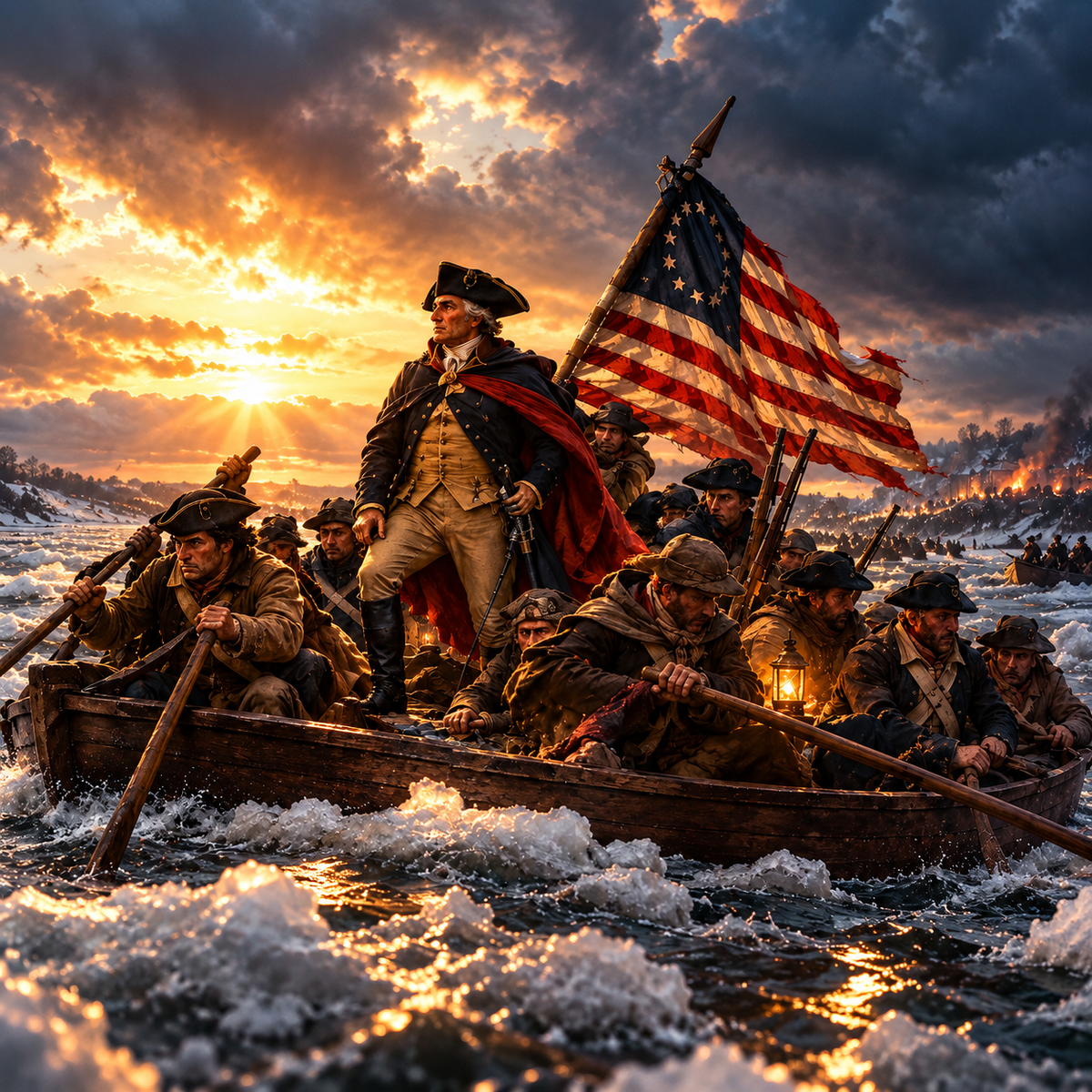
On Christmas night, December 25, Washington and part of his army crossed the Delaware River.
On the morning of December 26, American forces attacked the Hessian garrison at Trenton and won an important victory.
Trenton did not win the Revolution. It did not defeat the British Empire. And it did not guarantee American independence.
But at a moment when the American cause desperately needed evidence that it remained alive, Washington gave it a victory.
That makes Trenton a fitting conclusion to the story of 1776.
The year began with Americans debating whether they should become independent. It ended with Americans fighting to prevent independence from disappearing.
Why 1776 Changed History
1776 matters because of what happened on July 4. But it matters for much more than July 4.
It was the year reconciliation collapsed. It was the year thirteen colonies began transforming themselves into independent states. It was the year Americans declared that human beings possess rights that legitimate government exists to secure.
It was the year America announced itself to the world and began seeking international partnerships necessary for survival.
It was also a year of contradiction, division, military defeat, uncertainty, and fear.
That is precisely why its historical significance is so powerful.
The remarkable story of 1776 is not that American victory was inevitable. It is that Americans chose independence without knowing whether independence would survive.
According to The Chronicle of America, the Revolution became part of a larger process of national self-definition as Americans decided what principles their new society would embrace while leaving profound questions unresolved for future generations.
Those unresolved questions do not erase the achievement of 1776. They became part of America's continuing responsibility to live more fully according to the principles it proclaimed.
The achievement of 1776 was not simply declaring independence. It was beginning the transformation from thirteen colonies resisting an empire into thirteen states attempting to build a nation.
That required political ideas, functioning governments, public credit, military endurance, diplomacy, foreign assistance, and a willingness to continue after devastating setbacks.
What 1776 Asks of Us
History becomes little more than nostalgia if we remember the symbols but forget what they mean.
For Arsenal of Democracy, that is why 1776 is more than a date printed on a shirt.
Our mission is rooted in historically grounded storytelling because patriotism is strongest when it rests on truth—not mythology, not historical erasure, and not blind loyalty. AOD's purpose is to reconnect veterans, patriots, and everyday Americans with pride and purpose through patriotic storytelling and historical truth.
That means telling the entire story.
Remember the Declaration—but remember the uncertainty surrounding it. Celebrate the ideals—but understand the contradictions. Honor the Americans who fought—but remember the allies who helped them. Recognize the role of faith—but tell the truth about the diversity of belief and political opinion within colonial America.
And remember that liberty was never meant to be merely admired. It had to be understood, practiced, defended, and passed forward.
AOD connects the ideals of 1776 with independence, liberty, justice, faith, individual rights, national strength, and responsibility to future generations.
So don't just celebrate 1776. Study it.
Read the Declaration. Teach the next generation why it was written. Understand the principles behind the symbols you display and the clothing you wear. Remember the people who succeeded, the people who suffered, the people who disagreed, and the allies who helped make American independence possible.
Because liberty inherited without understanding can become liberty taken for granted.
Know the history. Understand the principles. Keep the faith. Carry them forward.
That is the enduring responsibility of 1776.
Explore the Arsenal of Democracy 1776 Collection →
Source Notes
The Chronicle of America / Harvest of Freedom, 1764–1788 (project historical source).
National Archives, Declaration of Independence: A History and Founding Documents Timeline.
National Archives, Declaration of Independence (1776).
U.S. Department of State, Office of the Historian, The United States and the French Alliance, 1778; historical material on French financial and military assistance.
National Park Service, Revolutionary War timelines and historical material on the 1776 New York/New Jersey campaign, the Delaware crossing, and Trenton.
Arsenal of Democracy Newsletter Jobs-To-Be-Done Framework (project strategy source).
Arsenal of Democracy Brand Image (project brand source).
U.S. Constitution, Article I, Section 8 (later federal powers to tax and borrow, included for the Revolutionary finance legacy).
Continental Congress / Great Seal history: Congress appointed the first Great Seal committee on July 4, 1776; the final seal and E Pluribus Unum were adopted in 1782.
Historical context on Continental finance and public debt: Continental currency, borrowing, state requisitions, and foreign loans financed the Revolutionary effort before the Constitution created a stronger federal fiscal system.
https://aod1776.com/blogs/voice-of-freedom/the-road-to-1776-how-america-chose-independence