
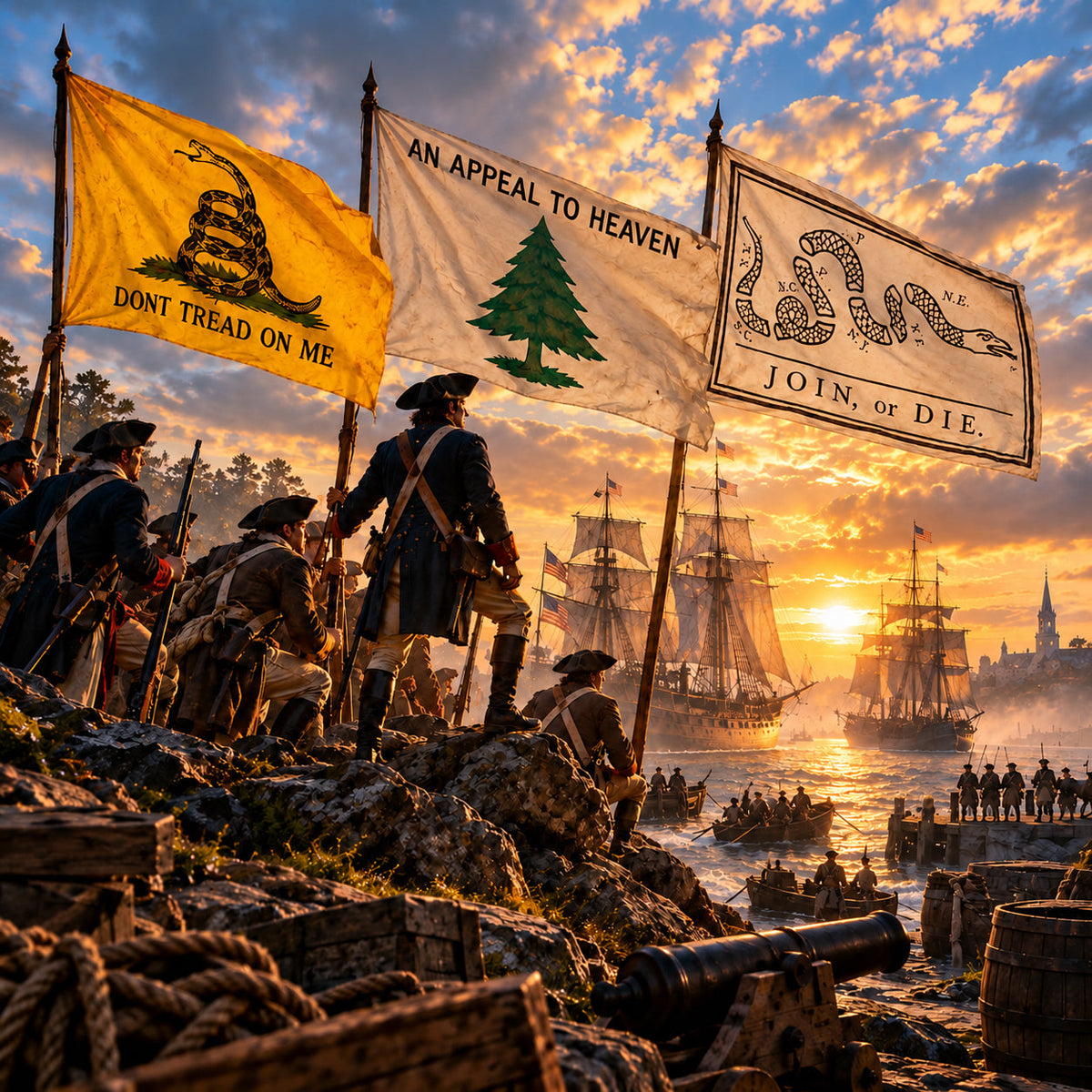
Arsenal of Democracy | Article 02
In 1763, most American colonists weren't trying to leave the British Empire.
They considered themselves British subjects. They participated in British trade, benefited from British military protection, and had grown accustomed to managing many of their own local affairs.
Thirteen years later, representatives of those colonies declared themselves independent states.
What happened? How did people who largely wanted to remain British become willing to fight Britain to create a new country?
The answer wasn't one tax, one battle, or one act of Parliament. American independence grew out of more than a decade of escalating disputes over taxation, representation, self-government, individual rights, and political authority - until enough colonists concluded that protecting their liberty required governing themselves.
America Before the Revolution
It's easy to look backward and assume the American Revolution was inevitable. It wasn't.
In the early 1760s, most colonists saw significant advantages to remaining within the British Empire. Britain offered access to international trade, military protection, and political stability. At the same time, the colonies had become accustomed to substantial control over their local affairs.
Colonial America was also deeply influenced by Christianity, although religious life differed considerably from colony to colony. New England had strong Puritan and Congregationalist traditions. Anglicanism was influential throughout much of the South. Pennsylvania became associated with William Penn and the Quakers. Maryland had important Catholic roots, while Baptists, Presbyterians, and other denominations became increasingly influential.
These communities did not create one uniform Christian political system. Some colonies maintained established churches, while others experimented with greater religious toleration. Yet Christianity was deeply woven into colonial culture. Ideas about God, providence, morality, conscience, human dignity, and the proper exercise of authority formed part of the environment in which Americans eventually debated liberty and government.
That long experience with local government, faith, and community responsibility mattered when Britain's relationship with the colonies began to change. Then came 1763.
1763: The Relationship Begins to Change
Britain had just defeated France in the French and Indian War - the North American theater of the larger Seven Years' War. Victory gave Britain enormous new territories, but years of warfare had also produced substantial government debt.
As London paid greater attention to the administration of its empire, British officials expected the American colonies to contribute more toward imperial costs. The colonists, however, had spent generations developing local assemblies and exercising considerable authority over taxation and their internal affairs.
That difference in experience produced a difference in political assumptions. What officials in London regarded as subordinate colonial legislatures, Americans increasingly regarded as institutions possessing legitimate political rights of their own.
Britain saw parliamentary authority. Increasing numbers of colonists saw a threat to rights they had come to regard as their own. That disagreement would turn a dispute over imperial administration into a much larger argument about liberty.
No Taxation Without Representation
The growing resistance is often summarized by one famous phrase: 'No taxation without representation.' But the dispute was about more than Americans simply wanting to pay less tax.
The deeper question was political authority. Could Parliament impose taxes on colonists who did not elect representatives to Parliament, or should internal taxation remain under colonial assemblies whose members the colonists actually elected?
That disagreement pushed Americans toward an even larger principle: consent. If legitimate government depended upon the consent of the governed, where did Parliament's authority over the colonies begin - and where did it end?
Those questions would eventually echo in the Declaration of Independence. But before Americans were prepared to declare independence, they spent years attempting resistance within the empire.
When Protest Became Resistance
The confrontation didn't explode overnight. It escalated over more than a decade.
In 1765, Parliament imposed the Stamp Act, a direct tax on printed materials in the colonies. Colonial resistance became so intense that Parliament eventually repealed it. The Townshend Acts followed in 1767, producing additional resistance.
In 1770, a confrontation between British soldiers and colonists in Boston turned deadly in what became known as the Boston Massacre. Three years later, opposition to the Tea Act culminated in the Boston Tea Party, when protesters dumped tea into Boston Harbor.
Britain answered in 1774 with punitive measures that Americans called the Intolerable Acts. Instead of isolating Massachusetts, those measures helped push previously divided colonies toward greater cooperation.
By then, the argument was no longer simply about taxes. It was becoming an argument about liberty, political authority, and whether Americans could be governed without meaningful control over the institutions making decisions for them.
That growing sense of common danger produced one of the most important political developments on the road to independence.
The First Continental Congress: Separate Colonies Find a Common Cause
In 1774, representatives from twelve colonies gathered in Philadelphia for the First Continental Congress. The colonies were still far from being one nation. They possessed different economies, religious traditions, political institutions, and regional interests.
Yet Britain's response to Massachusetts encouraged colonial leaders to recognize that a threat to the liberties of one colony might eventually become a threat to the liberties of others.
The Congress coordinated resistance and helped establish the habit of colonies acting together on questions that crossed colonial boundaries. That cooperation did not erase their differences, but it created an increasingly important sense of shared political purpose.
Long before E Pluribus Unum - 'Out of many, one' - became associated with the new United States, the revolutionary crisis was already forcing separate colonies to wrestle with the challenge of becoming one people.
Still, cooperation did not mean unanimity. The closer the colonies moved toward armed resistance, the more visible their internal divisions became.
Not Every Colonist Wanted Revolution
The road to independence did not unite every colonist behind the same cause.
Some increasingly believed British actions threatened their liberties and became Patriots. Others remained Loyalists who believed their rights, security, or duty were best preserved within the British Empire. Still others were uncertain, politically disengaged, attempted neutrality, or simply tried to protect their families and livelihoods as events moved beyond their control.
Religious conviction did not produce a single political answer either. Christian ministers could be found defending resistance, while other Christians believed loyalty to established authority remained a religious obligation. Quaker commitments to pacifism offered still another response.
That complexity matters. The Revolution was not simply a story of Americans suddenly uniting against Britain. It was also a struggle among people in the colonies over what loyalty, liberty, authority, faith, and citizenship required.
As petitions and political resistance failed to resolve the crisis, those disagreements moved into a more dangerous phase. An older colonial institution - the militia - was becoming increasingly important.
The Minutemen: Citizens Prepare to Defend Their Communities
Before there was an independent United States, there was already a long colonial militia tradition in which ordinary members of a community could be called upon for military service.
As tensions intensified in Massachusetts, selected militia members were organized for especially rapid response. These men became known as Minutemen because they were expected to be prepared to mobilize on short notice.
They were not a modern professional standing army. They were citizen-soldiers drawn from their communities - farmers, tradesmen, craftsmen, and neighbors - who trained and prepared for the possibility that they might be called to defend those communities.
Their historical importance therefore extends beyond the weapons they carried. The Minuteman came to represent an enduring American idea: citizenship carries responsibilities as well as rights, and preserving a free society may require ordinary citizens to accept obligations to their communities.
That idea was about to be tested. By early 1775, colonists in Massachusetts were gathering arms and organizing Minutemen as the confrontation with Britain approached.
On April 19, 1775, British troops moved toward Concord. Militia and Minutemen mobilized, and the resulting confrontations at Lexington and Concord opened the armed phase of the American Revolution.
Yet even the outbreak of fighting did not make independence inevitable. Many colonists still believed they were defending their traditional rights as British subjects rather than fighting to create an entirely separate nation.
From the Minuteman to the Second Amendment
The Minuteman also belongs to a larger American story that continued long after Lexington and Concord.
The Revolution forced Americans to confront difficult questions about military power. How should a republic defend itself? What role should citizen militias play? What authority should the states and national government possess? And how could Americans provide for national defense while remaining wary of concentrated military power and permanent standing armies?
Those questions did not produce a single simple answer. The Revolutionary experience demonstrated both the value and the limitations of militia forces, while the Continental Army showed the importance of trained, organized military power.
After independence, these experiences became part of the broader constitutional debate over national defense, federalism, militias, individual liberty, and the distribution of military authority.
When the Bill of Rights was ratified in 1791, the Second Amendment referred to a 'well regulated Militia' as 'necessary to the security of a free State' and protected 'the right of the people to keep and bear Arms.'
The historical connection should be understood carefully. The Second Amendment was not simply a constitutional memorial to the Minutemen of Lexington and Concord. It emerged from a much broader Anglo-American history involving arms, militias, individual rights, state authority, national defense, and concern about standing armies.
Still, the Revolution gave those questions immediate practical meaning. Americans had lived through a conflict in which citizen-soldiers and militias served alongside an emerging Continental Army. The constitutional generation therefore had firsthand reasons to debate how an armed citizenry, organized militia, professional military power, and individual liberty would coexist in a republic.
In that sense, the Minuteman became more than a figure from April 1775. He became a lasting symbol of readiness, citizenship, local responsibility, and the citizen-soldier tradition that remained part of America's constitutional and military development.
The Revolution Begins - But Independence Doesn't
Lexington and Concord changed the nature of the crisis. Political resistance had become armed conflict, but the colonies still had not declared independence.
Representatives assembled through the Continental Congress, and the conflict widened. Yet for many Americans, the objective remained the defense of their traditional liberties within the British Empire.
That fact makes the transformation of the next fourteen months even more significant. The men who assembled in 1775 did not know they were standing at the beginning of a new nation.
As fighting continued and reconciliation became increasingly difficult, the question changed. Americans were no longer asking only what rights they possessed as British subjects. Increasingly, they were asking whether they should remain British subjects at all.
1776 Changes Everything
By the summer of 1776, support for independence had grown dramatically. On July 4, the Continental Congress proclaimed the existence of a new nation: the United States of America.
But the Declaration did something more important than announce political separation. It made an extraordinary claim about the source of human rights.
The Declaration proclaimed that "all men are created equal" and are "endowed by their Creator with certain unalienable Rights."
That distinction remains fundamental to understanding the American founding. The Declaration's argument was not that government creates fundamental human rights. Instead, government exists to secure rights that precede government itself.
These ideas developed from multiple intellectual traditions - including natural-law philosophy, English constitutional history, Enlightenment thought, and a colonial culture profoundly influenced by Christianity.
Removing Christianity from that history would be inaccurate. So would pretending Christianity was its only influence. The American founding brought together ideas that had developed across centuries and placed them into a radical political proposition: legitimate government ultimately derives its authority from the people and exists to protect their rights.
Declaring Independence Was Only the Beginning
Declaring independence and winning independence were two very different things. The Americans were challenging one of the world's greatest military powers.
The war continued for years, and the American cause sometimes appeared close to failure. The principal British army eventually surrendered at Yorktown in 1781. Two years later, a peace settlement formally confirmed the existence of the United States.
Meanwhile, Americans faced another enormous challenge: they had to determine how a free people should govern themselves.
States began writing constitutions. Americans experimented with representative government. The Articles of Confederation created an initially weak national structure, and dissatisfaction with that system eventually contributed to the Constitution of 1787.
The Revolution had won independence. Building the republic - including deciding how liberty, military power, federal authority, state authority, and citizen responsibility should fit together - would prove to be another challenge entirely.
America's Founding Was Inspiring - and Imperfect
Celebrating 1776 does not require pretending the founding generation perfectly lived up to its principles. It didn't.
A nation proclaiming liberty continued to permit slavery. Native peoples experienced warfare, displacement, and loss of land. Women lacked many political rights. Religious minorities encountered discrimination in portions of colonial and early American society. Even Americans themselves were deeply divided over independence.
The Revolution was more than a rebellion against British authority. It was a process of national self-definition in which Americans decided which principles they would embrace while leaving major problems unresolved for future generations.
That contradiction shouldn't be erased. Neither should the ideals.
The country articulated extraordinary principles before it consistently extended those principles to everyone. That left future generations with a powerful question: If liberty and equality are American principles, who is entitled to them?
Americans would continue confronting that question through abolition, the Civil War and Reconstruction Amendments, women's suffrage, the civil rights movement, and other struggles over the meaning of American citizenship.
Understanding America's failures doesn't require abandoning its founding ideals. It requires understanding the responsibility those ideals created.
Why 1776 Still Matters
Nearly 250 years later, Americans continue debating many of the same fundamental questions: What are the proper limits of government? Where do individual rights come from? What responsibilities accompany liberty? What does citizenship require? How should a free nation defend itself? And what principles are worth preserving for another generation?
For Arsenal of Democracy, those aren't merely historical questions.
Our brand identifies 1776 with "Independence, Freedom, Liberty" and the determination to defend those principles. Our belief in "In God We Trust" reflects another part of America's historical inheritance: the conviction that morality, responsibility, liberty, and faith have played important roles in the American experience.
The Minuteman adds another dimension to that inheritance. His lasting significance is not simply that he carried a weapon. It is that he represents preparedness, service, civic responsibility, and the belief that freedom places obligations on the people who inherit it.
For us, 1776 isn't nostalgia. It's a reminder.
Patriotism doesn't require believing America has always gotten everything right. It means knowing the whole story - the courage and the failures, the victories and the contradictions, the faith and sacrifice, the principles and the struggle to live up to them - and deciding that the American experiment remains worth preserving and improving.
That's why Arsenal of Democracy believes American history should be learned rather than forgotten. Our goal is historically grounded storytelling that reconnects Americans with the principles, events, and symbols that shaped this nation.
The generation that lived through the road to 1776 couldn't know what the United States would eventually become. They simply reached a point when they believed their future should be their own.
Learn the history. Remember the principles. Keep the faith. Carry them forward.
That is the enduring legacy of 1776.
Source Notes
Harvest of Freedom, 1764-1788 (project historical source).
Declaration of Independence (1776).
United States Constitution and Bill of Rights; Second Amendment ratified in 1791.
Arsenal of Democracy Brand Image (project brand source).
Jobs-To-Be-Done Framework for Arsenal of Democracy Newsletter (project strategy source).
Editorial note: The Second Amendment discussion is framed as part of a broader Anglo-American militia, arms, federalism, and standing-army tradition rather than as a direct product of the Minutemen alone.